As a physical therapist, I love a challenge. One of my most formidable challenges is patients with tibial plateau fractures. Tibial plateau fractures are one of the most frustrating injuries for patients because it is such a long-drawn-out process. These fractures occur at the top of the tibia, or shin bone, which is a primary weight-bearing surface. Tibial plateau fractures are treated differently than fractures of the tibial shaft. When treating tibial plateau fractures, cartilage covers the top of the tibial plateau, which must be protected after these injuries in order to prevent arthritis. If the fracture is displaced, or isn’t lined up perfectly, the patient usually will need an open reduction internal fixation (ORIF). This means the surgeon will open the knee and use hardware, i.e., screw and plates, to hold the fractured bone in place. Whether displaced or non-displaced, the patient is usually non-weight bearing for an extended period of time, which lasts as long as three months. Additionally, if the meniscus is involved, the physician may immobilize the patient for an extended period of time as well. All of this adds up to a very stiff knee!
an example of a TPF from medical-definitions.com
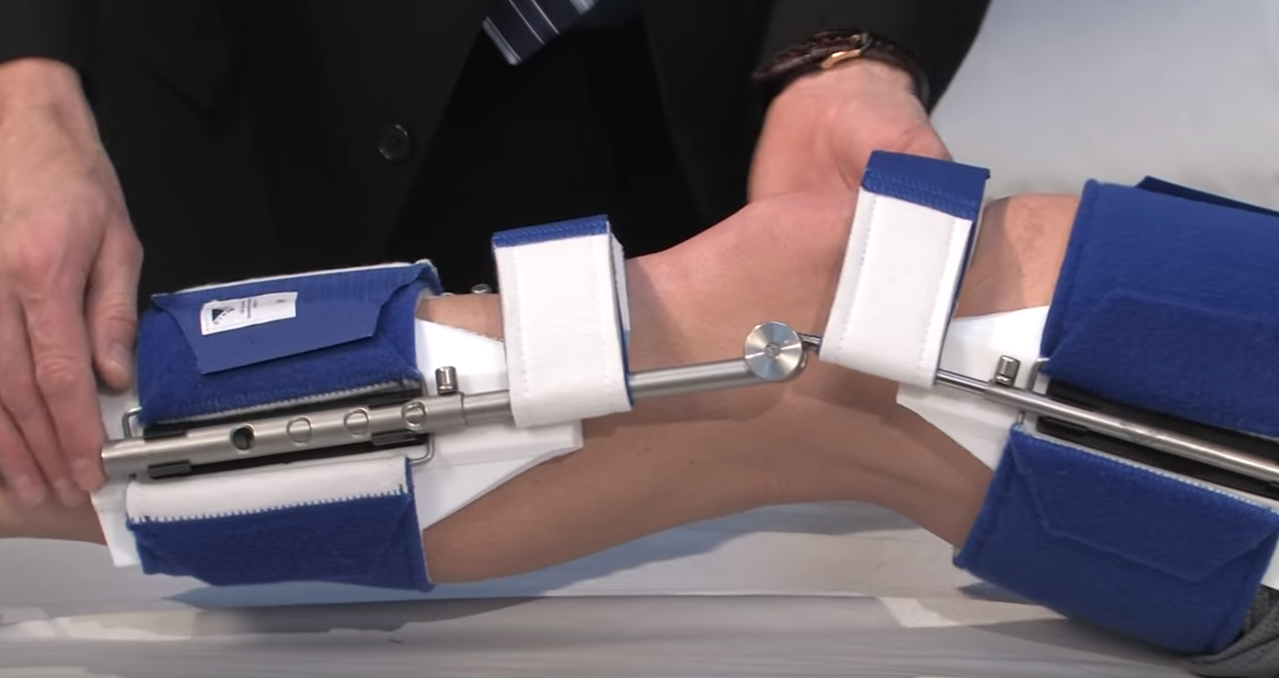
Regaining range of motion (ROM) is at the top of the list in rehab and does not come easily. Performing patellar joint mobilizations as soon as possible and establishing a solid home exercise program is vital. Gait training is always a part of the patient’s plan of care which progresses the patient from using a walker, to a cane, to independently ambulating without an assisted device. The gait training emphasizes heal strike, which is why straightening the knee is so crucial. Flexion, or bending the knee, can also be quite challenging and can make it difficult for the patient to go down steps, stand up from a sitting position, tie shoes and dress. Physical therapy visits are sometimes limited and there is much to be done while the patient is in the clinic. Utilizing time outside the clinic to regain ROM is crucial. A great modality that can be used at home is a Dynasplint. Dynasplint Knee Systems stretch the patient into extension or flexion and are available for every size patient. Remember, you can always wait to start strengthening, but you can’t wait to regain ROM. The longer you wait to regain ROM , the harder it will be.
NEW GIVEAWAY! You want the rehab victory, but the road to victory is never easy. So here’s a backpack that’s way more than a bag—it’s an extension of your will to achieve. The Under Armour PTH® Victory Backpack has front laundry locker to keep your sweaty gear separate from your daily gear. Tons of compartments keep you organized and wrapped in highly water-resistant, insanely durable material in Royal Blue, Black and White. When victory’s within reach, this bag will get you one step closer. Giveaway starts today and winner will be drawn next Thursday, Feb. 2 at Noon, EST. To enter, leave a comment here mentioning “range of motion.” Good luck!
It’s time for an update on the saga of my left foot. I have been very intentional about using all of the weapons in my arsenal and I am making serious strides (foot humor again) towards being out of pain. I have a couple of videos to share on stretching for plantar fasciitis relief. This first video comes from the Mayo Clinic, and does sum up much of my strategy, with one difference:
When the commentator mentions the night splint, she shows a splint that will hold the foot with the toes up. My splint not only holds the foot in the proper position, but is stretching the plantar fascia the whole time as well. Thus, I am killing two birds with one stone. Actually, I take a hot bath and an Aleve before donning my splint to bed, so I am, in fact killing 4 birds with the aforementioned stone; heat, anti-inflammatory, stretch, and splint foot up all night.
This next chill, California video shows a series of physical therapy stretches that are classic, and similar to those that my doctor gave me. An add added feature is the cameo appearance of their dog. You must be r-e-l-i-g-i-o-u-s about doing these exercises. Many have been known to come home from physical therapy with their list of homework exercises and toss them in the bill pile, never to be seen again. I would not be speaking from personal experience (much). The point is – do what the doctor tells you to do!
And now–a drum roll please. First I want to thank you all for your great comments. Blogging is exponentially more fun when the conversation goes both ways. I picked our winner using a random integer from this site. Congratulations to Jaime P. who commented on Jan. 23 at 10:10PM. Your Lululemon Align Ultra Yoga Mat and No Brainer Strap is packed and ready to ship.
Thanks for reading, stay well and drop back by tomorrow for the new giveaway announcement!
Article share today:Broken Arm Can Reorganize Brain
by Crystal Phend, Senior Staff Writer, MedPage Today (January 16, 2012)
Immobilized!
Getting a cast or splint causes the brain to rapidly shift its resources to make righties function better as lefties, researchers found.
Right-handed individuals whose dominant arm had to be immobilized after an injury showed a drop in cortical thickness in the area that controls primary motor and sensory areas for the hand, Nicolas Langer, MSc, of the University of Zurich in Switzerland, and colleagues reported.
Over the same two-week period, white and gray matter increased in the areas that controlled the uninjured left hand, suggesting “skill transfer from the right to the left hand,” the group reported in the Jan. 17 issue of Neurology.
The findings highlight the plasticity of the brain in rapidly adapting to changing demands, but also hold implications for clinical practice, they noted.
Rehabilitation after an injury that leaves one side of the body impaired, like stroke, often includes immobilizing the unaffected side to force use of the paralyzed limb. This practice likely hurts, at least temporarily, the neural networks for the other limb, Langer’s group pointed out. They seconded a maxim found in trauma surgery guidelines for immobilization of an injured extremity “as short as possible, as long as necessary.”
Whether the brain reorganization has long-lasting effects on function after the limb becomes mobile again isn’t clear, the researchers acknowledged. They had studied 10 right-handed adults (mean age 31.6) whose entire right arm and hand had to be immobilized for at least 14 days because of a fractured humerus or elbow. Performance on motor skill tests showed a big boost in scores for the left hand over the two weeks after injury (P=0.00016), presumably from compensating for the immobilized right hand in daily activities. MRI within 48 hours of the injury and another about 16 days afterward also showed big changes. Cortical thickness, reflecting gray matter, decreased only in the left hemisphere and mostly in the primary motor area (P=0.00015) and in two clusters in the primary somatosensory area (P=0.002 and P=0.003) that map to the hand area. Increases were seen in cortical thickness (P=0.00096) in the right primary motor cortex extending into the premotor cortex, which was correlated with improved motor skills in the left hand. Conversely, the greater the improvement in left hand motor performance, the greater the decrease in cortical thickness in the zone between the primary motor and somatosensory cortex (P=0.0015).
The MRI also showed that during the two weeks after the arm was immobilized there was a decrease in white matter on fractional anisotropy in the left corticospinal tract (P=0.024) without a change on the right side overall. Improved left hand motor skills did correlate, though, with increased white matter in a cluster in the upper right corticospinal tract (P=0.0002).
Because the gross morphology of neurons and their circuitry doesn’t dramatically change in the mature brain under normal conditions, the study results “suggest that the structure of the human brain is altered by deprivation and by transfer of skills from the right to the left upper extremity,” Langer’s group concluded. They cautioned, though, that the small number of individuals studied could have limited the quality of the correlation analysis and precluded examining gender differences.
For this article in its entirety, please click here.
(P.S.- The Lululemon Giveaway is still live until the winner is picked on Thursday. Click hereto enter by leaving a comment mentioning plantar fasciitis.)
Yesterday, January 23, 2012 was “Blue Monday.” The last Monday of a full week in January is called the most depressing day of the year. It’s a (pseudo) scientific fact and looks like this:
Weather=W, Debt=d, Time since Christmas=T, Time since failing our new year’s resolutions=Q, Low motivational levels=M and the feeling of a need to take action=Na.
Here at the Dynasplint mother ship in Severna Park, MD the weather was frozen fog to start, followed by drippy rain, overcast sky, slippery spots from leftover crusty ice, and it was cold. We never saw the sun. I will leave the rest of the equation to you, dear reader. How is your credit card debt from the holidays? Have you packed your holiday décor away, including your outside lights? How is it going with those New Year’s resolutions; have you made your bed every day, still had no cigarettes, or exercised every day? Dare I mention it- have you stepped on the scale?
When I look at the equation through my work lens, I think of all of the people out there who may be frustrated with limited function because of joint stiffness, or are just in pain. John Cassasa fell and injured his shoulder in Oct. of 2009. Like so many, he tried to get it to heal on its own. Turns out you cannot wish a torn biceps tendon away and when he finally had surgery in Feb. of 2010, his mobility was essentially zero. Post operatively he was immobilized for a month, and when he was cleared for physical therapy, he describes himself as “in a world of hurt.” Did he have low motivation levels or a need to take action? Watch his encouraging video to find out. (hint- he’s back on the golf course!!)
(PS- The Lululemon Giveaway is still live until the winner is picked on Thursday. Click hereto enter by leaving a comment mentioning plantar fasciitis)
The Global Soap Project recovers and recycles soap from American hotels and facilitates a process by which it is sanitized, melted and remolded into new bars, and then distributed to refugee camps in Africa. In 2010, GSP collected over 50 tons of soap that would have ended up in the landfills, produced 30,000 new bars of soap, and distributed bars to Kenya, Uganda, St. Lucia, Swaziland, Haiti, South Sudan and Ghana. The soap is distributed to organizations that have existing operations in these communities to ensure the soap gets to those in need, with the goal of improving health through personal hygiene.
Not only is hygiene being improved in Africa, but landfills are not filling with 50 tons of soap! By participating in GSP, hoteliers, such as Hilton Worldwide, are diverting tons of waste from the landfill and bolstering environmental sustainability programs. Hotel managers, housekeepers and guests become more environmentally conscious and more sensitive to the needs of vulnerable populations. Click on the video below to see the great work of GSP and its founder Derreck Kayongo, former refugee and one of this year’s CNN Hero finalists. So great!
(PS- The Lululemon Giveaway is still live until the winner is picked on Thursday. Click hereto enter by leaving a comment mentioning plantar fasciitis)
Happy Friday to everyone out here in the blogosphere! Because I am a giveaway virgin, I neglected to tell you all 2 things. A thousand pardons…
First- The winner of the Lululemon Align Ultra Yoga Mat and No Brainer Strap will be pulled next Thursday, January 26th.
Second- Anyone in the US and Canada can win.
Just leave a comment on yesterday’s post and mention “plantar fasciitis” and you are in it to win it.
Speaking of comments; you all are so encouraging, informative, helpful and downright hilarious.
At four o’clock my Dynasplint consultant arrived at my office. Back in Part 1, I shared with you all that I work for this company and so I was fortunate to meet her as she came in for other business. It feels so different to be the patient this time. I have been in the field video-taping patients, or in the edit bay helping to relate others’ experiences with Dynasplint and their stories, but today- it is my turn. My consultant custom fit my splint and then explained how to wear it. The trick is to have the ankle resting in a non-weight bearing position by placing a pillow under the knee and shin. So far- it’s easy breezy and pretty comfy.
In my Ankle Dynasplint
Now on to the challenge of how long to wear it and when. For Plantar Fasciitis, the very best results come from wearing this splint at night…overnight to be exact. Remember from yesterday’s post that there is a physiological reason for this. Now, I am not the best sleeper to begin with (thanks a lot, Dad and Grandpa) so I am concerned about this. My consultant said to wear it to bed, but the first time it woke me up to take it off and go back to sleep. Just building up to 6-8 hours is the goal.
My results so far:
1. On night one, I watched TV in the splint on the couch from 8-10:00PM and then wore it in bed until I woke up at 1:00AM when I took it off. The dogs woke us up at 6:00AM, so I put it back on for coffee and news time in bed (maybe my favorite part of the day) until about 7:45AM. When I add it up, I got about 6 ½ hours of wear time. Not bad…
2. On night two, I lasted until 2:00AM and then the same routine of ripping it off and putting back on early morning.
3. On nights 3 and 4, I slept through the night in my splint. I like lying on the non-splint side with a king-sized pillow between my legs with the good leg back and under, and the splint on top and forward. (I will need to photograph that one for you.)
4. Nights 5 and 6 were back to ½ and ½ and so it goes. I really don’t mind it, and can literally Velcro it on and off in my sleep. And I do.
And. . . . (drumroll please) It is making a difference already. Ask the husband about my first steps of the morning. There is much less racket because there is much less pain. I am very hopeful that over the next 3 months, I will experience that lasting change that’s promised.
During this entire saga, I haven’t treadmill-ed, or Zumba-ed, but I have been working out. As it turns out I love Bikram yoga! It’s great for my range of motion, flexibility and general well-being. Leave a comment with plantar fasciitis mentioned and you are entered in the Lululemon Align Ultra Mat and No Brainer Mat Strap FREE GIVEWAY. Now you too can fling your mat over your shoulder and head out to class with the cool kids. Keep moving!
When we last chatted (translate-I whined to you) about my left foot, I said that I took matter into my own hands. I have mounted a full-on attack to my plantar fasciitis (PF as known by the cool kids.) What exactly is PF? The plantar fascia, or arch tendon, is a thick band of tissue that runs from the heel to the front of the foot and functions to support the arch. Plantar fasciitis is an inflammatory condition that is brought about by overuse of the fascia due to: running, jumping, bearing significant weight for long periods of time, a lack of arch support in shoes or dancing (in aforementioned naughty shoes.)
The pain is the worst in the heel with the first steps of the morning, because the natural position of the foot while sleeping is with the foot relaxed and the toes slightly pointed down. Go ahead and try it, especially if you are reading this in bed. Snuggle in like you are sleeping and check out your feet. See? Toes are down, and in this position the plantar fascia is the shortest. Overnight, the tissue contracts slightly and when we step out onto the floor in the morning, the foot flexes and that terrible pain is actually micro tearing of the fascia. The cycle repeats itself each day and night. Time to shut.this.down. My plan:
1. When I was at the mean foot doctor she asked if I would like for her to tape my foot. I said yes, and the extra support did feel good under my arch. I googled (of course I did, because you know me and that’s how I ride) and ordered some KT Tape and learned how to wrap my foot for PF. Now- they show a trainer taping a foot but the trick is to do this on your own foot, but with practice, I can and I like the extra support.
My taping job!
2. I am taking Advil to reduce the inflammation. My co-worker who has hip issues swears by Aleve for joint pain vs. Advil for headache. Naproxen vs. Ibuprofen? Are all NSAIDs alike? What do you all say? Leave me a comment and I’ll update us in the next post.
3. This is the big one. I was bold and asked the mean podiatrist for an Ankle Dorsiflexion Dynasplint. She said, “Yea- I can give you a night splint.” Now I don’t know about you, but when I peruse Sky Mall and other foot catalogues (yup-they found me. I am on several mailing lists) for “Night Splints” that sock with band attached to the toes does not look legit. And the black boot thing? I feel like I would get claustrophobic in that thing. And the arch girdle? I think not. So, I was bold. I named the splint that I wanted and got the prescription. A few days later, I met with my consultant for my custom fitting and took my Ankle Dorsiflexion home.
Tomorrow’s post- The Saga of My Left Foot- Dynasplint-ing! (with a cool giveaway)
Kevin Wilk, DPT has been a physical therapist, researcher and educator for more than 25 years. He is currently Assoc. Clinical Director for Champion Sports Medicine (a Physiotherapy Facility) in Birmingham, AL. In addition, he is the Director of Rehabilitative Research at the American Sports Medicine Institute in Birmingham and is Adjunct Assistant Professor in the Physical Therapy Program at Marquette University in Milwaukee, WI. Kevin is also a Rehabilitation Consultant for the Tampa Bay Rays’ Baseball Team. He uses the LLPS found in the Shoulder Dynasplint for Rotator Cuff patients, Shoulder Instability patients who are stabilized, and Frozen Shoulder patients early to avoid the need for extended therapy.
Dynasplint is a proud sponsor of his lecture series and it is gratifying to listen to him share his knowledge with other clinicians. He is a great teacher and is willing to share his methods and ideas so all can benefit. It has been a pleasure to work and learn from Kevin over the past year.
Dr. John McGuire is Associate Professor of Physical Medicine and Rehabilitation at the Medical College of Wisconsin, and a specialist in stroke rehabilitation and spasticity management at Froedtert Hospital. He explains that following an incident to the brain such as a stroke there are three affects that can combine to create the bucket of challenges that is Upper Motor Neuron Syndrome. First, there is muscle under-activity, then muscle over-activity and finally contracture. The strategy that he employs is a two part attack on the spasticity that muscle over-activity presents. He injects either Botulinum toxin (Botox) or Intrathecal Baclofen in the elbow flexors to relax the over active muscle. Once the clenched elbow loosens up, one can stretch the joint and make gains in opening the arm up. The problem becomes how to maintain the new range of motion that has been accomplished. Dr. McGuire maintains that a proper splinting mechanism must be used to maintain that stretch, or the patient will reenervate right back where they were. A proper splint must accommodate and take advantage of the increased range of motion or they are right back to square one.
The neurological patient is an excellent candidate for dynamic splinting and thus, Dynasplint® Systems. The spring-loaded tension system safely accommodates a patient’s tone by moving with the patient during episodes of resistance or spasms. When tone is challenged with a consistent, even force that fatigues the muscle and mentally relaxes the patient to accept the Dynasplint®, the spring tension systems then bring the patient back to their end-range to continue a low-load, prolonged-duration stretch (LLPS). By normalizing tone and gaining range of motion (ROM) for the future, Dynasplint® Systems can be beneficial for existing contracture patients, as well as, those new patients who need early intervention.
Social Links